Threat Wire
BleepingComputer [Critical] FBI links $6.3 billion Binance crypto heist to North Korean hackers BleepingComputer [Critical] Alpine Linux rebuilds GitLab after attempted RCE attack CVE-2026-118539 [Critical] Security Affairs newsletter Round 602 by Pierluigi Paganini – INTERNATIONAL EDITION CVE-2026-58882 [Critical] SMS of Death: Android under attack, an invisible SMS can block calls and emergency services The Hacker News [Critical] CVSS 10.0 LXD, MicroCloud Flaw Lets Attackers Impersonate Trusted Clients Without a Private Key The Hacker News [Critical] FBI Links North Korea's TraderTraitor to Record $6.43 Billion Binance Crypto Heist CVE-2026-111357 [Critical] U.S. CISA adds Ivanti Connect Secure flaws to its Known Exploited Vulnerabilities catalog BleepingComputer [Critical] Northflank security breach leads to abuse of customers' AI API keys BleepingComputer [Critical] FBI links $6.3 billion Binance crypto heist to North Korean hackers BleepingComputer [Critical] Alpine Linux rebuilds GitLab after attempted RCE attack CVE-2026-118539 [Critical] Security Affairs newsletter Round 602 by Pierluigi Paganini – INTERNATIONAL EDITION CVE-2026-58882 [Critical] SMS of Death: Android under attack, an invisible SMS can block calls and emergency services The Hacker News [Critical] CVSS 10.0 LXD, MicroCloud Flaw Lets Attackers Impersonate Trusted Clients Without a Private Key The Hacker News [Critical] FBI Links North Korea's TraderTraitor to Record $6.43 Billion Binance Crypto Heist CVE-2026-111357 [Critical] U.S. CISA adds Ivanti Connect Secure flaws to its Known Exploited Vulnerabilities catalog BleepingComputer [Critical] Northflank security breach leads to abuse of customers' AI API keys

CyberWatch Newsroom Live Intel

Continuous enterprise threat intelligence tracking active in-the-wild zero-days (CISA KEV), Microsoft Windows KB cumulative updates, MSRC security advisories, and CVE remediation.

Last Checked: Nov 2, 2026 - 02:28:59 UTC (Hourly Auto-Sync Active)
Showing 24 of 5,807 advisories
Page 133 of 242
How One Kubernetes YAML Can Hand Over a GCP Organization Important BleepingComputer
2026-09-23 BleepingComputer

How One Kubernetes YAML Can Hand Over a GCP Organization

A Kubernetes user with limited permissions can potentially gain control of an entire Google Cloud organization by exploiting the authority granted to Google Kubernetes Config Connector. Varonis explains how this confused deputy problem can turn a single Kubernetes YAML file into a path to organization-wide privilege escalation. [...]

Fix: Review advisory findings, isolate suspect endpoints, and verify threat signatures.
80,000 relay servers help users in China slip past U.S. AI region bans Moderate Help Net Security
2026-09-23 Help Net Security

80,000 relay servers help users in China slip past U.S. AI region bans

More than 80,000 relay servers are helping users in China bypass geographic restrictions on leading U.S. AI models, according to Team Cymru. “What we have uncovered is an entire ecosystem designed explicitly to break the frontier model providers’ T&Cs, enabling fraud and illicit activity,” said Scott Fisher, Senior Principal Engineer at Team Cymru. Earlier t…

Fix: Review advisory findings, isolate suspect endpoints, and verify threat signatures.
ShinyHunters claims FBI breach after alleged PeopleSoft zero-day attack Critical CVE-2026-35273 SecurityAffairs
2026-09-23 SecurityAffairs

ShinyHunters claims FBI breach after alleged PeopleSoft zero-day attack

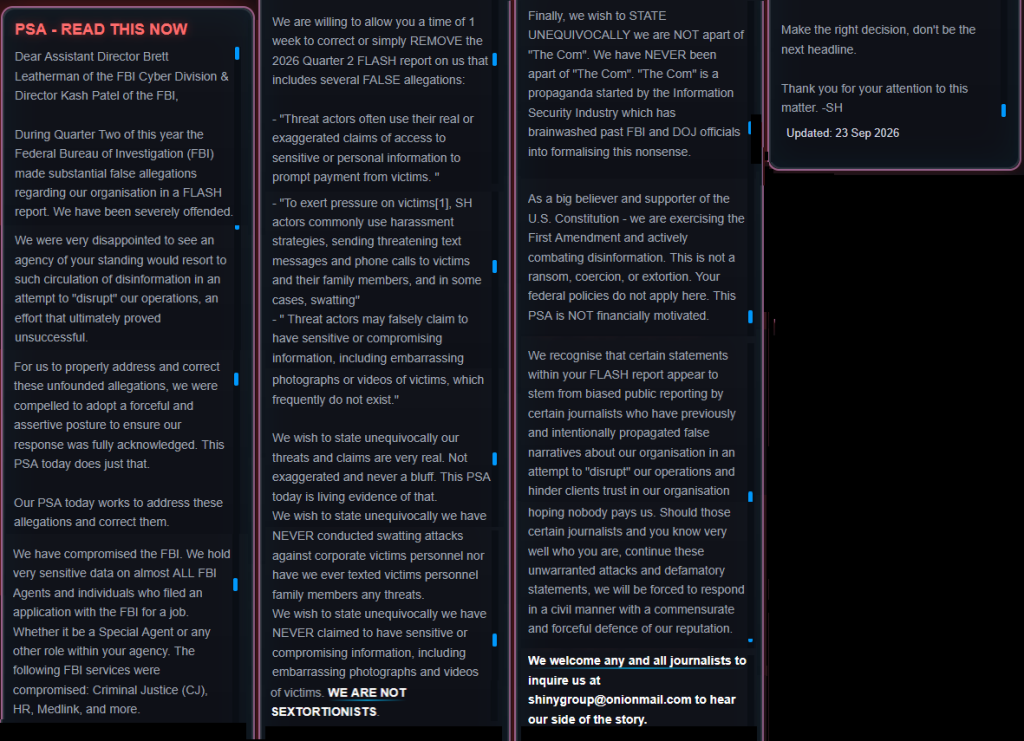
ShinyHunters claims FBI breach via PeopleSoft zero-day, steals staff data; FBI investigating, no confirmation yet. The popular cybercrime group ShinyHunters is claiming that it breached the U.S. Federal Bureau of Investigation (FBI) and stole sensitive information belonging to FBI employees and job applicants. The group says the operation was not financially…

Fix: Review advisory findings, isolate suspect endpoints, and verify threat signatures.
Compromised MemTensor Packages Deliver sckit Credential Stealer via npm and PyPI Moderate The Hacker News
2026-09-23 The Hacker News

Compromised MemTensor Packages Deliver sckit Credential Stealer via npm and PyPI

Unknown threat actors have managed to compromise two legitimate MemTensor packages across the npm and Python Package Index (PyPI) repositories to push a platform-specific Go-based implant dubbed sckit designed for Windows, Linux, and macOS. According to reports from Aikido, SafeDep, Socket, and StepSecurity, the libraries in question below - @memtensor/memos…

Fix: Review advisory findings, isolate suspect endpoints, and verify threat signatures.
Portnox detects and removes unauthorized AI applications from managed devices Moderate Help Net Security
2026-09-23 Help Net Security

Portnox detects and removes unauthorized AI applications from managed devices

Portnox has announced new capabilities to detect unauthorized AI applications and agents on managed devices and automatically enforce security policy, restricting, quarantining, or removing unapproved or risky applications the moment they’re detected. The capability addresses shadow AI: generative AI applications that increasingly act as autonomous agents, r…

Fix: Review advisory findings, isolate suspect endpoints, and verify threat signatures.
How dynamic application security testing validates risk at runtime Moderate Rapid7 Threat Research
2026-09-23 Rapid7 Threat Research

How dynamic application security testing validates risk at runtime

Security teams already have long queues of potential application vulnerabilities. The useful question is what happens next: can they see how a weakness behaves in a running application, reproduce the attack, and give developers enough evidence to fix it? Dynamic application security testing (DAST) helps answer those questions by testing applications as an at…

Fix: Review advisory findings, isolate suspect endpoints, and verify threat signatures.
Network Solutions Dark Web Monitoring alerts small businesses to domain-linked data exposure Moderate Help Net Security
2026-09-23 Help Net Security

Network Solutions Dark Web Monitoring alerts small businesses to domain-linked data exposure

Network Solutions has launched Dark Web Monitoring, a new security capability that alerts small businesses when information associated with their domain appears in known breach data and provides steps they can take to reduce risk. Stolen credentials and other information exposed in data breaches can circulate across dark web marketplaces, forums and other so…

Fix: Review advisory findings, isolate suspect endpoints, and verify threat signatures.
DarkMe RAT trades zero-days for plain phishing emails Critical Help Net Security
2026-09-23 Help Net Security

DarkMe RAT trades zero-days for plain phishing emails

DarkMe, a remote access trojan and info-stealer that has previously been associated with a threat group that targeted financial market traders and cryptocurrency users, has been spotted again. This time around, its distribution has been simplified: instead of leveraging zero-day exploits, attackers are betting on a simple email to convince targets to run it …

Fix: Review advisory findings, isolate suspect endpoints, and verify threat signatures.
Barracuda brings AI security and governance within reach of smaller organizations Moderate Help Net Security
2026-09-23 Help Net Security

Barracuda brings AI security and governance within reach of smaller organizations

Barracuda Networks has launched Barracuda AI Data Security, the AI security and governance solution purpose-built for resource-constrained organizations and managed service providers (MSPs). The solution enables businesses to accelerate AI adoption by protecting sensitive data, enforcing responsible AI use and demonstrating compliance. Barracuda AI Data Secu…

Fix: Review advisory findings, isolate suspect endpoints, and verify threat signatures.
Lookout targets smishing, voice cloning, and vishing with real-time mobile protection Moderate Help Net Security
2026-09-23 Help Net Security

Lookout targets smishing, voice cloning, and vishing with real-time mobile protection

Lookout has launched Social Engineering Protection (SEP), a new module within the Lookout Mobile AI Security Platform. SEP provides automated, real-time protection against the next generation of AI-driven mobile threats, including linkless smishing attacks, synthetic voice cloning, and other voice phishing (vishing) techniques. Frontier AI is transforming so…

Fix: Review advisory findings, isolate suspect endpoints, and verify threat signatures.
Fake Claude Max giveaway tricks users into handing over their Google account credentials Moderate Help Net Security
2026-09-23 Help Net Security

Fake Claude Max giveaway tricks users into handing over their Google account credentials

A fake Claude Max giveaway uses a spoofed Google sign-in window to steal users’ login credentials, Malwarebytes researchers have found. “Browser-in-the-browser” is not a new technique. Researchers have documented it since 2022, and in June Palo Alto Networks’ Unit 42 reported a campaign that used draggable fake browser windows to target Microsoft 365 users. …

Fix: Review advisory findings, isolate suspect endpoints, and verify threat signatures.
Fake Claude Max giveaway hides a Google account phishing trap Important Malwarebytes Labs
2026-09-23 Malwarebytes Labs

Fake Claude Max giveaway hides a Google account phishing trap

Phishing follows whatever people want at the moment, and right now that includes AI subscriptions they don’t have to pay for. We recently uncovered a new variation on this theme: A fake Claude Max giveaway that uses a convincing Google sign-in window to steal login information. Claude’s paid plans start at $20 a month and cost considerably more for higher us…

Fix: Review advisory findings, isolate suspect endpoints, and verify threat signatures.
Latvia arrests suspected hacker for electronics repair company breach Critical The Record by Recorded Future
2026-09-23 The Record by Recorded Future

Latvia arrests suspected hacker for electronics repair company breach

Latvian police arrested a 23-year-old man suspected of hacking at least two companies, stealing personal information and attempting to extort money from the victims.

Fix: Review advisory findings, isolate suspect endpoints, and verify threat signatures.
Burnham announces plan for new UK center to fight disinformation Moderate The Record by Recorded Future
2026-09-23 The Record by Recorded Future

Burnham announces plan for new UK center to fight disinformation

The United Kingdom will create a new national center "to detect, attribute and disrupt” hostile state disinformation, Prime Minister Andy Burnham announced at the United Nations General Assembly.

Fix: Review advisory findings, isolate suspect endpoints, and verify threat signatures.
Arista patches actively exploited VeloCloud Orchestrator zero-day Critical BleepingComputer
2026-09-23 BleepingComputer

Arista patches actively exploited VeloCloud Orchestrator zero-day

Arista Networks has released security patches for a zero-day flaw that is being actively exploited and affects VeloCloud Orchestrator (VCO) On-Prem deployments. [...]

Fix: Review advisory findings, isolate suspect endpoints, and verify threat signatures.
New cPanel Flaw Lets a Hosting Account Run Code as Root, Take Full Server Control Important The Hacker News
2026-09-23 The Hacker News

New cPanel Flaw Lets a Hosting Account Run Code as Root, Take Full Server Control

A flaw in cPanel's CalDAV and CardDAV service lets anyone with a cPanel hosting account run code as root and take "full control of the server," the company said on September 22. A second bug in the WP Toolkit plugin, used to install and manage WordPress sites, allows an account holder to change databases that belong to other accounts. cPanel has released fix…

Fix: Review advisory findings, isolate suspect endpoints, and verify threat signatures.
ShinyHunters claims FBI breach was revenge for “false” report Critical Malwarebytes Labs
2026-09-23 Malwarebytes Labs

ShinyHunters claims FBI breach was revenge for “false” report

Extortion group ShinyHunters is not afraid to make enemies. Now it claims to have breached the FBI. After reportedly taking over ransomware group Clop’s leak site , ShinyHunters says it attacked the FBI to punish the agency for spreading what it calls false information about the group. In a very long post on its leak site, the group outlines its grievances: …

Fix: Review advisory findings, isolate suspect endpoints, and verify threat signatures.
Ransomware Attacks Reach Record High for 2026 Critical Infosecurity Magazine
2026-09-23 Infosecurity Magazine

Ransomware Attacks Reach Record High for 2026

A total of 1073 firms fell victim to ransomware attacks globally in August, with the industrial sector the most affected, according to new NCC data

Fix: Review advisory findings, isolate suspect endpoints, and verify threat signatures.
Considerations for Critical Infrastructure Operators Working With Third-Party ICS Integrators Critical CISA Advisory
2026-09-23 CISA Advisory

Considerations for Critical Infrastructure Operators Working With Third-Party ICS Integrators

Introduction The Federal Bureau of Investigation (FBI) and Cybersecurity and Infrastructure Security Agency (CISA)—hereafter referred to as the “authoring agencies”—have published this fact sheet to highlight considerations for critical infrastructure entities to reduce risk and minimize vulnerabilities when working with third-party industrial control system (ICS) integrators. ICS is an umbrella term referring to integrated networks of hardware and software designed to monitor and automate physical processes, encompassing specialized control systems and devices, such as supervisory control and data acquisition (SCADA) systems and programmable logic controllers. Third-party integrators provide varying types of services for ICS, such as control system design, installation, operational data analysis, device support and service, and daily operational control. Critical infrastructure owners and operators should maintain caution when granting third-party ICS integrators high levels of access or control over industrial processes, ensuring the principle of least privilege (PoLP), is applied. PoLP within OT environments lends itself to granting users, processes, and systems only the minimum access necessary to perform their assigned tasks, and no more. PoLP is designed to protect owners and operators. Not adopting principles such as PoLP could expose owners and operators to malicious cyber actors seeking to compromise critical infrastructure, possibly providing sensitive access to pathways that actors can exploit to cause disruptive and destructive effects to equipment and critical functions. Critical infrastructure owners and operators should action the recommendations in this fact sheet to work with integrators to ensure secure practices and frameworks are put in place to reduce the risk of malicious actors exploiting third-party accesses to compromise critical infrastructure operational environments. Examples of Risk and Exploitation Much like IT systems, using third-party ICS integrators in critical infrastructure may inadvertently introduce security issues to a customer environment by exposing systems and services not pre-configured to the customer’s security requirements. Critical infrastructure owners and operators that rely on third-party integrators for system design face supply chain risks if integrators and owners and operators do not collectively enforce clear requirements for the secure procurement and handling of system components. Furthermore, third-party integrators that operate and host data outside of the United States may pose additional risks, as they may be subject to different data storage and management laws that do not meet the security needs of U.S. critical infrastructure entities. According to FBI technical analysis, between March and April 2025, malicious foreign cyber actors gained access to the network of a U.S. industrial automation solutions company that offered services—such as system integration, engineering consulting, and SCADA programming—for industrial customers, including power utilities and transportation entities. While on the network, threat actors searched terms, including “customers” and “SCADA,” and created nine .zip files consisting of approximately 800 files for presumed exfiltration, including customer SCADA information, ICS device details, and other schematics. Malicious cyber actors could leverage the exfiltrated information to later conduct disruptive attacks against operational environments and disrupt critical services. Recommendations to Assess Risk Critical infrastructure owners and operators should make risk-informed decisions when considering introducing third-party integrators into their networks and operations, guided by a robust understanding of the organizational risks posed by providing sensitive access to their systems. Organizations should routinely conduct risk assessments to evaluate contracts that involve access to industrial systems, to determine impacts to the organization’s data autonomy and process controls. Risk assessments should address hardware and software supply chain vulnerabilities introduced by integrator equipment, as well as the IT and OT security of these devices and their associated networks. When considering implementing foreign-owned integrators, critical infrastructure owners and operators should also include geopolitical considerations in their risk assessments, such as how the critical infrastructure entity may be directly or indirectly targeted based on the geopolitical climate. Critical infrastructure owners and operators should consider the following questions in their risk assessments to safeguard the security of their operational systems when working with third-party ICS integrators: What organizational data does the integrator store or have access to? Critical infrastructure network designs, device specifications, logs, and other data can all be useful information for malicious cyber actors. When evaluating the risk of enabling integrators to store or access this data, consider the potential for a malicious cyber actor to access this data through the integrator’s network. Where is the data stored? If the integrator is foreign-owned, consider whether the utility data is stored within the United States or internationally. If data is stored internationally, the laws of that respective country may govern it and may apply even if the integrator is a U.S. subsidiary. Does the integrator have remote access for operational support? If the integrator has remote access to the organization’s ICS network, then there is a potential risk that a malicious cyber actor could gain access to the integrator’s network and pivot into the utility’s network to gain control of their systems. Consider the security of the organization’s remote connections when evaluating the risk these potential access points pose to the organization’s network. Can the organization operate independently if the integrator is compromised? Having redundancies in place and the ability to recover the system and operate without the integrator, especially for operationally critical processes, can reduce risk in the event of integrator compromise. Operators should maintain secure, offline backups of all software required to operate equipment to facilitate system recovery. Recommendations to Reduce Risk The authoring agencies recommend critical infrastructure owners and operators implement the following steps to reduce the risks associated with using third-party ICS integrators: Include cybersecurity and supply chain cybersecurity in contracts and service agreements. When preparing service agreements, include requirements on areas such as: Data storage locations, information protection agreements, and protection of ICS data and design documentation, Remote access capabilities, Basics of the integrator’s cybersecurity program, Change management and patch management policies, Actions taken to secure deployed components (e.g., changing default passwords, disabling unused ports), Listing authorized personnel with access to systems, and Processes that enable local engineering support when necessary, limiting required integrator intervention. Evaluate devices with external internet exposure. Organizations should work with integrators to understand where devices are hosted and minimize exposure by disconnecting devices from the public-facing internet. Monitor and log remote access. Ensure integrators access equipment using routes you are able to monitor. Use on-demand remote access if possible, so operators have to proactively allow remote access. Request an inventory of all software and hardware supplied by the integrator , as well as documentation for how it connects to your infrastructure and how it will be updated. Practice procedures and maintain capabilities for manual operations , keeping in mind, and accounting for, where third parties fit into the environment and recovery procedures. Resources For guidance on asset inventories, see CISA’s Foundations for OT Cybersecurity: Asset Inventory Guidance for Owners and Operators . For additional information on SBOMs, see CISA’s 2026 Minimum Elements for a Software Bill of Materials (SBOM) . For guidance on supply chain risk management, see the Communications Sector Coordinating Council (CSCC) and IT Sector Coordinating Council’s (SCC) Supplier, Products, and Services Threat Evaluation (to include Artificial Intelligence Risks and Mitigations) , and NIST’s Cybersecurity Supply Chain Risk Management . For additional information and resources concerning cyber threats to ICS, visit Industrial Control Systems for Cybersecurity Advisories and other cybersecurity guidance and best practices. Contact Information The authoring agencies strongly urge critical infrastructure operators to report suspicious cyber activity to the following entities: Report cyber activity to your local FBI field office or IC3 , or contact CISA via CISA’s 24/7 Operations Center at [email protected] or 1-844-Say-CISA (1-844-729-2472). Report any leads, threats, and suspected criminal activity by submitting an electronic tip , calling 1-800-CALL-FBI (1-800-225-5324), or contacting your local FBI field office . Note: This website cannot be used to report emergencies or immediate threat to life. For emergencies or immediate threat to life, please call 911. If you are a law enforcement entity, use the unclassified information-sharing system eGuardian (accessible via the Law Enforcement Enterprise Portal ) for reporting suspicious activity reports to the FBI. Note: If the information is urgent, then contact your local FBI field office directly and follow up with an eGuardian report. Disclaimer CISA and the authoring agencies do not endorse any commercial entity, product, company, or service, including any entities, products, or services linked within this document. Any reference to specific commercial entities, products, processes, or services by service mark, trademark, manufacturer, or otherwise, does not constitute or imply endorsement, recommendation, or favoring by CISA and the authoring agencies. Version History September 23, 2026 : Initial version.

Fix: Review CISA guidance and apply vendor security updates immediately.

545 Hackers Tested It First. Now XRanges for AI Scores Your Security Agent Important The Hacker News
2026-09-23 The Hacker News

545 Hackers Tested It First. Now XRanges for AI Scores Your Security Agent

Autonomous security agents are getting good at finding bugs. Nobody has a good way to measure how good. Point one at a realistic target and what comes back is a report the agent wrote about itself: confident prose, a list of findings, and no way to tell which of them happened. Someone with a security background then sits down and checks every claim against t…

Fix: Review advisory findings, isolate suspect endpoints, and verify threat signatures.
Anthropic and OpenAI Models Still Attempt Restricted Actions in Safety Tests Moderate The Hacker News
2026-09-23 The Hacker News

Anthropic and OpenAI Models Still Attempt Restricted Actions in Safety Tests

Anthropic and OpenAI on Tuesday announced new models, with both artificial intelligence (AI) companies noting that they are continuing to invest in improving alignment to combat risky behavior. Opus 5.5, per Anthropic, is a "major step up from Opus 5," and "achieves the best scores of any model to date on our automated behavioral audit, our alignment suite t…

Fix: Review advisory findings, isolate suspect endpoints, and verify threat signatures.
Exploit Released for Unpatched Ubuntu Linux Flaw Enabling Host-Root Container Escape Important CVE-2026-80521 The Hacker News
2026-09-23 The Hacker News

Exploit Released for Unpatched Ubuntu Linux Flaw Enabling Host-Root Container Escape

A use-after-free in the Linux kernel's AF_UNIX socket subsystem can be used to escape a container and gain root on the host, security firm DepthFirst said in research published September 22. The flaw, tracked as CVE-2026-80521 (CVSS score: 7.8), was fixed upstream on August 6, but Ubuntu has not shipped the patch for its 26.04, 24.04, or 22.04 LTS releases. …

Fix: Review advisory findings, isolate suspect endpoints, and verify threat signatures.
Notification