Threat Wire
BleepingComputer [Critical] FBI links $6.3 billion Binance crypto heist to North Korean hackers BleepingComputer [Critical] Alpine Linux rebuilds GitLab after attempted RCE attack CVE-2026-118539 [Critical] Security Affairs newsletter Round 602 by Pierluigi Paganini – INTERNATIONAL EDITION CVE-2026-58882 [Critical] SMS of Death: Android under attack, an invisible SMS can block calls and emergency services The Hacker News [Critical] CVSS 10.0 LXD, MicroCloud Flaw Lets Attackers Impersonate Trusted Clients Without a Private Key The Hacker News [Critical] FBI Links North Korea's TraderTraitor to Record $6.43 Billion Binance Crypto Heist CVE-2026-111357 [Critical] U.S. CISA adds Ivanti Connect Secure flaws to its Known Exploited Vulnerabilities catalog BleepingComputer [Critical] Northflank security breach leads to abuse of customers' AI API keys BleepingComputer [Critical] FBI links $6.3 billion Binance crypto heist to North Korean hackers BleepingComputer [Critical] Alpine Linux rebuilds GitLab after attempted RCE attack CVE-2026-118539 [Critical] Security Affairs newsletter Round 602 by Pierluigi Paganini – INTERNATIONAL EDITION CVE-2026-58882 [Critical] SMS of Death: Android under attack, an invisible SMS can block calls and emergency services The Hacker News [Critical] CVSS 10.0 LXD, MicroCloud Flaw Lets Attackers Impersonate Trusted Clients Without a Private Key The Hacker News [Critical] FBI Links North Korea's TraderTraitor to Record $6.43 Billion Binance Crypto Heist CVE-2026-111357 [Critical] U.S. CISA adds Ivanti Connect Secure flaws to its Known Exploited Vulnerabilities catalog BleepingComputer [Critical] Northflank security breach leads to abuse of customers' AI API keys

CyberWatch Newsroom Live Intel

Continuous enterprise threat intelligence tracking active in-the-wild zero-days (CISA KEV), Microsoft Windows KB cumulative updates, MSRC security advisories, and CVE remediation.

Last Checked: Nov 2, 2026 - 02:28:59 UTC (Hourly Auto-Sync Active)
Showing 24 of 5,807 advisories
Page 190 of 242
Revolut scam wave steals £180,000 from Jersey residents in just four weeks Moderate Graham Cluley Security
2026-09-02 Graham Cluley Security

Revolut scam wave steals £180,000 from Jersey residents in just four weeks

If you live in Jersey and bank with Revolut, you should be on your guard against scam phone calls. Because local police on the largest of the Channel Islands have warned that over a single four-week period, an astonishing 75% of all scam crime reports they have received have involved Revolut accounts Read more in my article on the Hot for Security blog.

Fix: Review advisory findings, isolate suspect endpoints, and verify threat signatures.
CISA Adds Seven Known Exploited Vulnerabilities to Catalog Critical CISA Advisory
2026-09-02 CISA Advisory

CISA Adds Seven Known Exploited Vulnerabilities to Catalog

CISA has added seven new vulnerabilities to its Known Exploited Vulnerabilities (KEV) Catalog , based on evidence of active exploitation. CVE-2026-9586 Sangoma Switchvox SQL Injection Vulnerability CVE-2026-48710 Kludex Starlette HTTP Request/Response Smuggling Vulnerability CVE-2026-49869 Kestra OSS OS Command Injection Vulnerability CVE-2026-59822 BerriAI LiteLLM Improper Authentication Vulnerability CVE-2026-82329 JFrog Artifactory Improper Authentication Vulnerability CVE-2026-83548 SonicWall SMA1000 Appliances Server-Side Request Forgery Vulnerability CVE-2026-83549 SonicWall SMA1000 Appliances OS Command Injection Vulnerability These types of vulnerabilities are a frequent attack vector for malicious cyber actors and pose significant risks to the federal enterprise. Binding Operational Directive (BOD) 26-04: Prioritizing Security Updates Based on Risk establishes vulnerability management requirements for Federal Civilian Executive Branch (FCEB) agencies. BOD 26-04 reinforces the importance of the KEV Catalog and requires federal agencies to prioritize rapid remediation of high-risk vulnerabilities, specifically those identified by Common Vulnerabilities and Exposures (CVEs) listed in CISA’s KEV Catalog on publicly exposed assets that grant total control of the asset post-exploitation, while deferring action for lower-risk vulnerabilities. BOD 26-04 further establishes basic expectations for when agencies must check whether threat actors compromised the system before the patch was applied. While BOD 26-04 applies only to FCEB agencies, CISA encourages all organizations to adopt risk-based vulnerability management and prioritize remediation of KEV Catalog vulnerabilities . CISA will continue to add vulnerabilities to the catalog that meet the specified criteria . Aware of an exploited vulnerability not currently listed in the KEV Catalog? Submit it for potential addition through CISA’s KEV Nomination Form . Potential KEV additions must have a CVE ID, evidence of exploitation, and clear mitigation guidance.

Fix: Review CISA guidance and apply vendor security updates immediately.
Communicating Under Pressure: Best Practices for Service Providers Important CISA Advisory
2026-09-02 CISA Advisory

Communicating Under Pressure: Best Practices for Service Providers

Developed by CISA, the Federal Bureau of Investigation, and international partners, this guidance describes how organizations can plan and execute clear, timely, accurate, and audience-appropriate communications during IT and operational technology (OT) outages. Whether caused by cyber threat actors, human error, equipment failure, or natural hazards, service outages can create disruption and societal panic even without speculation from end users and the public as added factors. Outages at one organization may cascade across interconnected systems, increasing uncertainty and alarm. The guidance emphasizes clarity, accountability, and transparency as core principles and details key elements of effective crisis messaging to inform affected stakeholders and the public while aligning with legal requirements, operational security, law enforcement, and containment efforts. CISA’s CI Fortify initiative provides information and resources that help critical infrastructure organizations prepare to isolate and recover vital OT systems during a major cyber incident or crisis. Changes in service availability, whether from outages or isolation as a defensive strategy, require transparent and ongoing communication to help end users minimize operational impact, limit speculation, and preserve trust. For emergency planning purposes, critical infrastructure owners and operators should assume that telecommunications services may be disrupted or otherwise unreliable, making it crucial for organizations to have crisis communications plans in place that integrate backup communication methods and understand the type of communication they should expect from their service providers.

Fix: Review CISA guidance and apply vendor security updates immediately.
Gaming the system: how a Chinese-speaking actor turned Brazilian government sites into an SEO weapon Moderate Check Point Research
2026-09-02 Check Point Research

Gaming the system: how a Chinese-speaking actor turned Brazilian government sites into an SEO weapon

Research by: Amit Yardeni Key Points A Chinese-speaking actor is now targeting Brazil. Check Point Research has uncovered a sustained campaign against Brazilian organizations, primarily government and educational institutions since mid-2025. We dubbed this group Gambling Goblin: a Chinese-speaking cybercrime cluster connected to a previously documented group…

Fix: Review advisory findings, isolate suspect endpoints, and verify threat signatures.
An AI-Assisted Cyber Attack: Inside a Unit 42 Investigation Important Palo Alto Unit 42
2026-09-02 Palo Alto Unit 42

An AI-Assisted Cyber Attack: Inside a Unit 42 Investigation

Using autonomous AI agents, an attacker breached an enterprise network in a matter of hours. Understand how to address and defend against agentic attacks. The post An AI-Assisted Cyber Attack: Inside a Unit 42 Investigation appeared first on Unit 42 .

Fix: Review advisory findings, isolate suspect endpoints, and verify threat signatures.
FBI Probes Service Selling 153M+ Drivers Licenses Moderate KrebsOnSecurity
2026-09-01 KrebsOnSecurity

FBI Probes Service Selling 153M+ Drivers Licenses

A new identity theft service launched on the dark web this week is selling digital scans of more than 153 million drivers licenses from people in the United States and Canada. Based on interviews with individuals whose licenses are available for purchase on this service, it appears to be siphoning images collected by a widely-used identity verification company based in Louisiana. KrebsOnSecurity a...

Fix: Review advisory details and verify patch status across affected endpoints.
Rockwell Automation Historian ME Important CISA Advisory
2026-09-01 CISA Advisory

Rockwell Automation Historian ME

View CSAF Summary Successful exploitation of these vulnerabilities could crash the device being accessed; an out-of-bounds write condition may allow remote code execution. The following versions of Rockwell Automation Historian ME are affected: Series B 5.202 (CVE-2025-12768, CVE-2026-12661) Series C 7.101 (CVE-2025-12768, CVE-2026-12661) CVSS Vendor Equipment Vulnerabilities v3 8 Rockwell Automation Rockwell Automation Historian ME Out-of-bounds Write, Stack-based Buffer Overflow Background Critical Infrastructure Sectors: Chemical, Critical Manufacturing, Food and Agriculture, Healthcare and Public Health, Water and Wastewater Systems Countries/Areas Deployed: Worldwide Company Headquarters Location: United States Vulnerabilities Expand All + CVE-2025-12768 A security issue exists within FactoryTalk Historian Machine Edition. An attacker with low-level authentication could exploit this vulnerability to achieve remote code execution on the affected device. View CVE Details Affected Products Rockwell Automation Historian ME Vendor: Rockwell Automation Product Version: Rockwell Automation Series B: 5.202, Rockwell Automation Series C: 7.101 Product Status: known_affected Remediations Mitigation Customers using the affected software, who are not able to upgrade to one of the corrected versions, should use Rockwell Automations security best practices found at: https://support.rockwellautomation.com/app/answers/answer_view/a_id/1085012/loc/en_US#__highlight Mitigation If you have any questions regarding the security issue(s) above and how to mitigate them, contact TechConnect for help. More information can be found at: https://www.rockwellautomation.com/en-us/company/about-us/contact-us.html Mitigation If you have any questions regarding this disclosure, please contact PSIRT Email: [email protected] Relevant CWE: CWE-787 Out-of-bounds Write Metrics CVSS Version Base Score Base Severity Vector String 3.1 8 HIGH CVSS:3.1/AV:A/AC:L/PR:L/UI:N/S:U/C:H/I:H/A:H 4.0 8.6 HIGH CVSS:4.0/AV:A/AC:L/AT:N/PR:L/UI:N/VC:H/VI:H/VA:H/SC:N/SI:N/SA:N CVE-2026-12661 A denial-of-service security issue exists within FactoryTalk Historian Machine Edition. A network adjacent attacker who is authenticated could send crafted requests to the web interface, resulting in buffer overflow conditions that may cause the device to crash and become unresponsive. View CVE Details Affected Products Rockwell Automation Historian ME Vendor: Rockwell Automation Product Version: Rockwell Automation Series B: 5.202, Rockwell Automation Series C: 7.101 Product Status: known_affected Remediations Mitigation Customers using the affected software, who are not able to upgrade to one of the corrected versions, should use Rockwell Automations security best practices found at: https://support.rockwellautomation.com/app/answers/answer_view/a_id/1085012/loc/en_US#__highlight Mitigation If you have any questions regarding the security issue(s) above and how to mitigate them, contact TechConnect for help. More information can be found at: https://www.rockwellautomation.com/en-us/company/about-us/contact-us.html Mitigation If you have any questions regarding this disclosure, please contact PSIRT Email: [email protected] Relevant CWE: CWE-121 Stack-based Buffer Overflow Metrics CVSS Version Base Score Base Severity Vector String 3.1 4.5 MEDIUM CVSS:3.1/AV:A/AC:L/PR:H/UI:N/S:U/C:N/I:N/A:H 4.0 4.8 MEDIUM CVSS:4.0/AV:A/AC:L/AT:N/PR:H/UI:N/VC:N/VI:N/VA:L/SC:N/SI:N/SA:N Acknowledgments Rockwell Automation reported these vulnerabilities to CISA Legal Notice and Terms of Use This product is provided subject to this Notification ( https://www.cisa.gov/notification ) and this Privacy & Use policy ( https://www.cisa.gov/privacy-policy ). Recommended Practices CISA recommends users take defensive measures to minimize the risk of exploitation of these vulnerabilities. Minimize network exposure for all control system devices and/or systems, ensuring they are not accessible from the internet. Locate control system networks and remote devices behind firewalls and isolating them from business networks. When remote access is required, use more secure methods, such as Virtual Private Networks (VPNs), recognizing VPNs may have vulnerabilities and should be updated to the most current version available. Also recognize VPN is only as secure as the connected devices. CISA reminds organizations to perform proper impact analysis and risk assessment prior to deploying defensive measures. CISA also provides a section for control systems security recommended practices on the ICS webpage on cisa.gov/ics. Several CISA products detailing cyber defense best practices are available for reading and download, including Improving Industrial Control Systems Cybersecurity with Defense-in-Depth Strategies. CISA encourages organizations to implement recommended cybersecurity strategies for proactive defense of ICS assets. Additional mitigation guidance and recommended practices are publicly available on the ICS webpage at cisa.gov/ics in the technical information paper, ICS-TIP-12-146-01B--Targeted Cyber Intrusion Detection and Mitigation Strategies. Organizations observing suspected malicious activity should follow established internal procedures and report findings to CISA for tracking and correlation against other incidents. CISA also recommends users take the following measures to protect themselves from social engineering attacks: Do not click web links or open attachments in unsolicited email messages. Refer to Recognizing and Avoiding Email Scams for more information on avoiding email scams. Refer to Avoiding Social Engineering and Phishing Attacks for more information on social engineering attacks. No known public exploitation specifically targeting these vulnerabilities has been reported to CISA at this time. Revision History Initial Release Date: 2026-09-01 Date Revision Summary 2026-09-01 1 Initial Publication Legal Notice and Terms of Use

Fix: Review CISA guidance and apply vendor security updates immediately.

Rockwell Automation Redundancy Module Configuration Tool Important CISA Advisory
2026-09-01 CISA Advisory

Rockwell Automation Redundancy Module Configuration Tool

View CSAF Summary Successful exploitation of these vulnerabilities could allow for an attacker to escalate and execute processes with administrator privileges. The following versions of Rockwell Automation Redundancy Module Configuration Tool are affected: Redundancy Module Configuration Tool 10.00.00 (CVE-2026-9633) Redundancy Module Configuration Tool >=9.00.00| CVSS Vendor Equipment Vulnerabilities v3 7.3 Rockwell Automation Rockwell Automation Redundancy Module Configuration Tool Incorrect Default Permissions Background Critical Infrastructure Sectors: Critical Manufacturing Countries/Areas Deployed: Worldwide Company Headquarters Location: United States Vulnerabilities Expand All + CVE-2026-9633 A security issue exists within the Redundancy Module Configuration Tool. The RM3ConfigTool.exe binary searches directories in the system path for a required DLL, and one or more of these directories may be writable by standard (non administrator) users due to incorrect default permissions. If a local attacker places a malicious DLL in such a directory and an administrator subsequently runs the tool, the malicious DLL is loaded into the elevated process and executes with Administrator/SYSTEM privileges. View CVE Details Affected Products Rockwell Automation Redundancy Module Configuration Tool Vendor: Rockwell Automation Product Version: Rockwell Automation Redundancy Module Configuration Tool: 10.00.00 Product Status: known_affected Remediations Vendor fix Rockwell Automation has released Redundancy Module Configuration Tool version 10.01.00 for users to install. Mitigation Customers using the affected software, who are not able to upgrade to one of the corrected versions, should use Rockwell Automation's security best practices (https://support.rockwellautomation.com/app/answers/answer_view/a_id/1085012/loc/en_US#__highlight). https://support.rockwellautomation.com/app/answers/answer_view/a_id/1085012/loc/en_US#__highlight Mitigation For more information, see Rockwell Automation Security Advisories: https://www.rockwellautomation.com/en-us/trust-center/security-advisories.html. https://www.rockwellautomation.com/en-us/trust-center/security-advisories.html Relevant CWE: CWE-276 Incorrect Default Permissions Metrics CVSS Version Base Score Base Severity Vector String 3.1 7.3 HIGH CVSS:3.1/AV:L/AC:L/PR:L/UI:R/S:U/C:H/I:H/A:H 4.0 7 HIGH CVSS:4.0/AV:L/AC:L/AT:N/PR:L/UI:P/VC:H/VI:H/VA:H/SC:N/SI:N/SA:N CVE-2026-9634 A security issue exists within the Redundancy Module Configuration Tool. The RMConfigTool.exe binary searches directories in the system path for a required DLL, and one or more of these directories may be writable by standard (non-administrator) users due to incorrect default permissions. If a local attacker places a malicious DLL in such a directory and an administrator subsequently runs the tool, the malicious DLL is loaded into the elevated process and executes with Administrator/SYSTEM privileges. View CVE Details Affected Products Rockwell Automation Redundancy Module Configuration Tool Vendor: Rockwell Automation Product Version: Rockwell Automation Redundancy Module Configuration Tool: >=9.00.00| Product Status: known_affected Remediations Vendor fix Rockwell Automation has released Redundancy Module Configuration Tool version 10.01.00 for users to install. Mitigation Customers using the affected software, who are not able to upgrade to one of the corrected versions, should use Rockwell Automation's security best practices (https://support.rockwellautomation.com/app/answers/answer_view/a_id/1085012/loc/en_US#__highlight). https://support.rockwellautomation.com/app/answers/answer_view/a_id/1085012/loc/en_US#__highlight Mitigation For more information, see Rockwell Automation Security Advisories: https://www.rockwellautomation.com/en-us/trust-center/security-advisories.html. https://www.rockwellautomation.com/en-us/trust-center/security-advisories.html Relevant CWE: CWE-276 Incorrect Default Permissions Metrics CVSS Version Base Score Base Severity Vector String 3.1 7.3 HIGH CVSS:3.1/AV:L/AC:L/PR:L/UI:R/S:U/C:H/I:H/A:H 4.0 7 HIGH CVSS:4.0/AV:L/AC:L/AT:N/PR:L/UI:P/VC:H/VI:H/VA:H/SC:N/SI:N/SA:N Acknowledgments Rockwell Automation reported these vulnerabilities to CISA Legal Notice and Terms of Use This product is provided subject to this Notification (https://www.cisa.gov/notification) and this Privacy & Use policy (https://www.cisa.gov/privacy-policy). Recommended Practices CISA recommends users take defensive measures to minimize the risk of exploitation of these vulnerabilities. Minimize network exposure for all control system devices and/or systems, ensuring they are not accessible from the internet. Locate control system networks and remote devices behind firewalls and isolating them from business networks. When remote access is required, use more secure methods, such as Virtual Private Networks (VPNs), recognizing VPNs may have vulnerabilities and should be updated to the most current version available. Also recognize VPN is only as secure as the connected devices. CISA reminds organizations to perform proper impact analysis and risk assessment prior to deploying defensive measures. CISA also provides a section for control systems security recommended practices on the ICS webpage on cisa.gov/ics. Several CISA products detailing cyber defense best practices are available for reading and download, including Improving Industrial Control Systems Cybersecurity with Defense-in-Depth Strategies. CISA encourages organizations to implement recommended cybersecurity strategies for proactive defense of ICS assets. Additional mitigation guidance and recommended practices are publicly available on the ICS webpage at cisa.gov/ics in the technical information paper, ICS-TIP-12-146-01B--Targeted Cyber Intrusion Detection and Mitigation Strategies. Organizations observing suspected malicious activity should follow established internal procedures and report findings to CISA for tracking and correlation against other incidents. CISA also recommends users take the following measures to protect themselves from social engineering attacks: Do not click web links or open attachments in unsolicited email messages. Refer to Recognizing and Avoiding Email Scams for more information on avoiding email scams. Refer to Avoiding Social Engineering and Phishing Attacks for more information on social engineering attacks. No known public exploitation specifically targeting these vulnerabilities has been reported to CISA at this time. These vulnerabilities are not exploitable remotely. Revision History Initial Release Date: 2026-09-01 Date Revision Summary 2026-09-01 1 Initial Republication of Rockwell Automation Security Advisory Legal Notice and Terms of Use

Fix: Review CISA guidance and apply vendor security updates immediately.

Rockwell Automation RSLinx Classic Important CISA Advisory
2026-09-01 CISA Advisory

Rockwell Automation RSLinx Classic

View CSAF Summary Successful exploitation of these vulnerabilities could allow an attacker to cause a denial-of-service condition on the affected product. The following versions of Rockwell Automation RSLinx Classic are affected: RSLinx Classic CVSS Vendor Equipment Vulnerabilities v3 8.6 Rockwell Automation Rockwell Automation RSLinx Classic Integer Overflow or Wraparound, Integer Underflow (Wrap or Wraparound), Buffer Copy without Checking Size of Input ('Classic Buffer Overflow') Background Critical Infrastructure Sectors: Critical Manufacturing Countries/Areas Deployed: Worldwide Company Headquarters Location: United States Vulnerabilities Expand All + CVE-2026-9621 A denial-of-service security issue exists within RSLinx Classic. The security issue stems from improper handling of a malformed packet. A crafted CIP packet can cause the RSLinx Classic service to crash, requiring a restart of the service to recover. View CVE Details Affected Products Rockwell Automation RSLinx Classic Vendor: Rockwell Automation Product Version: Rockwell Automation RSLinx Classic: Product Status: known_affected Remediations Vendor fix Rockwell Automation has corrected the vulnerabilities in RSLinx Classic version 4.60. Mitigation Users using the affected software, who are not able to upgrade to one of the corrected versions, should use Rockwell Automation's security best practices https://support.rockwellautomation.com/app/answers/answer_view/a_id/1085012/loc/en_US#__highlight. https://support.rockwellautomation.com/app/answers/answer_view/a_id/1085012/loc/en_US#__highlight Mitigation For more information, see Rockwell Automation Security Advisories: https://www.rockwellautomation.com/en-us/trust-center/security-advisories.html. https://www.rockwellautomation.com/en-us/trust-center/security-advisories.html Relevant CWE: CWE-190 Integer Overflow or Wraparound Metrics CVSS Version Base Score Base Severity Vector String 3.1 8.6 HIGH CVSS:3.1/AV:N/AC:L/PR:N/UI:N/S:C/C:N/I:N/A:H 4.0 9.2 CRITICAL CVSS:4.0/AV:N/AC:L/AT:N/PR:N/UI:N/VC:N/VI:N/VA:H/SC:N/SI:N/SA:H CVE-2026-9622 A denial-of-service security issue exists within RSLinx Classic. A crafted CIP packet targeting the Forward Close service can cause the RSLinx Classic service to crash, requiring a restart of the service to recover. View CVE Details Affected Products Rockwell Automation RSLinx Classic Vendor: Rockwell Automation Product Version: Rockwell Automation RSLinx Classic: Product Status: known_affected Remediations Vendor fix Rockwell Automation has corrected the vulnerabilities in RSLinx Classic version 4.60. Mitigation Users using the affected software, who are not able to upgrade to one of the corrected versions, should use Rockwell Automation's security best practices https://support.rockwellautomation.com/app/answers/answer_view/a_id/1085012/loc/en_US#__highlight. https://support.rockwellautomation.com/app/answers/answer_view/a_id/1085012/loc/en_US#__highlight Mitigation For more information, see Rockwell Automation Security Advisories: https://www.rockwellautomation.com/en-us/trust-center/security-advisories.html. https://www.rockwellautomation.com/en-us/trust-center/security-advisories.html Relevant CWE: CWE-191 Integer Underflow (Wrap or Wraparound) Metrics CVSS Version Base Score Base Severity Vector String 3.1 8.6 HIGH CVSS:3.1/AV:N/AC:L/PR:N/UI:N/S:C/C:N/I:N/A:H 4.0 9.2 CRITICAL CVSS:4.0/AV:N/AC:L/AT:N/PR:N/UI:N/VC:N/VI:N/VA:H/SC:N/SI:N/SA:H CVE-2026-9624 A denial-of-service security issue exists within RSLinx Classic. A crafted CIP packet can cause the RSLinx Classic service to crash due to insufficient data length validation, requiring a restart of the service to recover. View CVE Details Affected Products Rockwell Automation RSLinx Classic Vendor: Rockwell Automation Product Version: Rockwell Automation RSLinx Classic: Product Status: known_affected Remediations Vendor fix Rockwell Automation has corrected the vulnerabilities in RSLinx Classic version 4.60. Mitigation Users using the affected software, who are not able to upgrade to one of the corrected versions, should use Rockwell Automation's security best practices https://support.rockwellautomation.com/app/answers/answer_view/a_id/1085012/loc/en_US#__highlight. https://support.rockwellautomation.com/app/answers/answer_view/a_id/1085012/loc/en_US#__highlight Mitigation For more information, see Rockwell Automation Security Advisories: https://www.rockwellautomation.com/en-us/trust-center/security-advisories.html. https://www.rockwellautomation.com/en-us/trust-center/security-advisories.html Relevant CWE: CWE-191 Integer Underflow (Wrap or Wraparound) Metrics CVSS Version Base Score Base Severity Vector String 3.1 7.5 HIGH CVSS:3.1/AV:N/AC:L/PR:N/UI:N/S:U/C:N/I:N/A:H 4.0 8.7 HIGH CVSS:4.0/AV:N/AC:L/AT:N/PR:N/UI:N/VC:N/VI:N/VA:H/SC:N/SI:N/SA:N CVE-2026-9625 A denial-of-service security issue exists within RSLinx Classic. A crafted CIP packet with an oversized embedded message request can cause the RSLinx Classic service to crash, requiring a restart of the service to recover. View CVE Details Affected Products Rockwell Automation RSLinx Classic Vendor: Rockwell Automation Product Version: Rockwell Automation RSLinx Classic: Product Status: known_affected Remediations Vendor fix Rockwell Automation has corrected the vulnerabilities in RSLinx Classic version 4.60. Mitigation Users using the affected software, who are not able to upgrade to one of the corrected versions, should use Rockwell Automation's security best practices https://support.rockwellautomation.com/app/answers/answer_view/a_id/1085012/loc/en_US#__highlight. https://support.rockwellautomation.com/app/answers/answer_view/a_id/1085012/loc/en_US#__highlight Mitigation For more information, see Rockwell Automation Security Advisories: https://www.rockwellautomation.com/en-us/trust-center/security-advisories.html. https://www.rockwellautomation.com/en-us/trust-center/security-advisories.html Relevant CWE: CWE-120 Buffer Copy without Checking Size of Input ('Classic Buffer Overflow') Metrics CVSS Version Base Score Base Severity Vector String 3.1 7.5 HIGH CVSS:3.1/AV:N/AC:L/PR:N/UI:N/S:U/C:N/I:N/A:H 4.0 8.7 HIGH CVSS:4.0/AV:N/AC:L/AT:N/PR:N/UI:N/VC:N/VI:N/VA:H/SC:N/SI:N/SA:N Acknowledgments Rockwell Automation reported these vulnerabilities to CISA Legal Notice and Terms of Use This product is provided subject to this Notification (https://www.cisa.gov/notification) and this Privacy & Use policy (https://www.cisa.gov/privacy-policy). Recommended Practices CISA recommends users take defensive measures to minimize the risk of exploitation of these vulnerabilities. Minimize network exposure for all control system devices and/or systems, ensuring they are not accessible from the internet. Locate control system networks and remote devices behind firewalls and isolating them from business networks. When remote access is required, use more secure methods, such as Virtual Private Networks (VPNs), recognizing VPNs may have vulnerabilities and should be updated to the most current version available. Also recognize VPN is only as secure as the connected devices. CISA reminds organizations to perform proper impact analysis and risk assessment prior to deploying defensive measures. CISA also provides a section for control systems security recommended practices on the ICS webpage on cisa.gov/ics. Several CISA products detailing cyber defense best practices are available for reading and download, including Improving Industrial Control Systems Cybersecurity with Defense-in-Depth Strategies. CISA encourages organizations to implement recommended cybersecurity strategies for proactive defense of ICS assets. Additional mitigation guidance and recommended practices are publicly available on the ICS webpage at cisa.gov/ics in the technical information paper, ICS-TIP-12-146-01B--Targeted Cyber Intrusion Detection and Mitigation Strategies. Organizations observing suspected malicious activity should follow established internal procedures and report findings to CISA for tracking and correlation against other incidents. CISA also recommends users take the following measures to protect themselves from social engineering attacks: Do not click web links or open attachments in unsolicited email messages. Refer to Recognizing and Avoiding Email Scams for more information on avoiding email scams. Refer to Avoiding Social Engineering and Phishing Attacks for more information on social engineering attacks. No known public exploitation specifically targeting these vulnerabilities has been reported to CISA at this time. Revision History Initial Release Date: 2026-09-01 Date Revision Summary 2026-09-01 1 Initial Republication of Rockwell Automation Advisory Legal Notice and Terms of Use

Fix: Review CISA guidance and apply vendor security updates immediately.

Rockwell Automation Logix Platform Important CISA Advisory
2026-09-01 CISA Advisory

Rockwell Automation Logix Platform

View CSAF Summary The following versions of Rockwell Automation Logix Platform are affected: ControlLogix 5580 CompactLogix 5380 GuardLogix 5580 Compact GuardLogix 5380 CVSS Vendor Equipment Vulnerabilities v3 7.5 Rockwell Automation Rockwell Automation Logix Platform Improper Restriction of Operations within the Bounds of a Memory Buffer Background Critical Infrastructure Sectors: Critical Manufacturing Countries/Areas Deployed: Worldwide Company Headquarters Location: United States Vulnerabilities Expand All + CVE-2026-9637 A denial-of-service vulnerability exists in the affected Logix platforms due to improper validation of input length during CIP message processing. This can result in a major nonrecoverable fault (MNRF), requiring a power cycle to recover. View CVE Details Affected Products Rockwell Automation Logix Platform Vendor: Rockwell Automation Product Version: Rockwell Automation ControlLogix 5580 Product Status: known_affected Remediations Vendor fix Rockwell Automation recommends users update to firmware version V37.011. Vendor fix Rockwell Automation recommends users update to firmware version 34.015. Vendor fix Rockwell Automation recommends users update to firmware version 35.014. Vendor fix Rockwell Automation recommends users update to firmware version 36.013. Mitigation Customers using the affected software who are not able to upgrade to one of the corrected versions should use Rockwell Automation's security best practices. Relevant CWE: CWE-119 Improper Restriction of Operations within the Bounds of a Memory Buffer Metrics CVSS Version Base Score Base Severity Vector String 3.1 7.5 HIGH CVSS:3.1/AV:N/AC:L/PR:N/UI:N/S:U/C:N/I:N/A:H 4.0 8.7 HIGH CVSS:4.0/AV:N/AC:L/AT:N/PR:N/UI:N/VC:N/VI:N/VA:H/SC:N/SI:N/SA:N Acknowledgments Rockwell Automation reported this vulnerability to CISA Legal Notice and Terms of Use This product is provided subject to this Notification (https://www.cisa.gov/notification) and this Privacy & Use policy (https://www.cisa.gov/privacy-policy). Recommended Practices CISA recommends users take defensive measures to minimize the risk of exploitation of these vulnerabilities. Minimize network exposure for all control system devices and/or systems, ensuring they are not accessible from the internet. Locate control system networks and remote devices behind firewalls and isolating them from business networks. When remote access is required, use more secure methods, such as Virtual Private Networks (VPNs), recognizing VPNs may have vulnerabilities and should be updated to the most current version available. Also recognize VPN is only as secure as the connected devices. CISA reminds organizations to perform proper impact analysis and risk assessment prior to deploying defensive measures. CISA also provides a section for control systems security recommended practices on the ICS webpage on cisa.gov/ics. Several CISA products detailing cyber defense best practices are available for reading and download, including Improving Industrial Control Systems Cybersecurity with Defense-in-Depth Strategies. CISA encourages organizations to implement recommended cybersecurity strategies for proactive defense of ICS assets. Additional mitigation guidance and recommended practices are publicly available on the ICS webpage at cisa.gov/ics in the technical information paper, ICS-TIP-12-146-01B--Targeted Cyber Intrusion Detection and Mitigation Strategies. Organizations observing suspected malicious activity should follow established internal procedures and report findings to CISA for tracking and correlation against other incidents. CISA also recommends users take the following measures to protect themselves from social engineering attacks: Do not click web links or open attachments in unsolicited email messages. Refer to Recognizing and Avoiding Email Scams for more information on avoiding email scams. Refer to Avoiding Social Engineering and Phishing Attacks for more information on social engineering attacks. No known public exploitation specifically targeting these vulnerabilities has been reported to CISA at this time. Revision History Initial Release Date: 2026-09-01 Date Revision Summary 2026-09-01 1 Initial republication of Rockwell Automation advisory Legal Notice and Terms of Use

Fix: Review CISA guidance and apply vendor security updates immediately.
Rockwell Automation FactoryTalk Activation Manager Important CISA Advisory
2026-09-01 CISA Advisory

Rockwell Automation FactoryTalk Activation Manager

View CSAF Summary The following versions of Rockwell Automation FactoryTalk Activation Manager are affected: FactoryTalk Activation Manager V5.02_and_below (CVE-2026-16675) CVSS Vendor Equipment Vulnerabilities v3 7.8 Rockwell Automation Rockwell Automation FactoryTalk Activation Manager Improper Restriction of Excessive Authentication Attempts Background Critical Infrastructure Sectors: Critical Manufacturing Countries/Areas Deployed: Worldwide Company Headquarters Location: United States Vulnerabilities Expand All + CVE-2026-16675 A privilege escalation vulnerability exists within FactoryTalk Activation Manager. The vulnerability stems from custom actions in the installer that spawn visible console windows running with SYSTEM privileges during installation or repair operations. An authenticated attacker with Windows credentials could hijack these console windows to obtain a SYSTEM-level command prompt, allowing full access to all files, processes, and system resources. View CVE Details Affected Products Rockwell Automation FactoryTalk Activation Manager Vendor: Rockwell Automation Product Version: Rockwell Automation FactoryTalk Activation Manager V5.02_and_below Product Status: known_affected Remediations Vendor fix Rockwell Automation recommends users update to software version V5.03. Mitigation Customers using the affected software who are not able to upgrade to one of the corrected versions should use Rockwell Automation's security best practices. Relevant CWE: CWE-307 Improper Restriction of Excessive Authentication Attempts Metrics CVSS Version Base Score Base Severity Vector String 3.1 7.8 HIGH CVSS:3.1/AV:L/AC:L/PR:L/UI:N/S:U/C:H/I:H/A:H 4.0 8.5 HIGH CVSS:4.0/AV:L/AC:L/AT:N/PR:L/UI:N/VC:H/VI:H/VA:H/SC:N/SI:N/SA:N Acknowledgments An anonymous security researcher reported this vulnerability to Rockwell Automation, who reported it to CISA Legal Notice and Terms of Use This product is provided subject to this Notification (https://www.cisa.gov/notification) and this Privacy & Use policy (https://www.cisa.gov/privacy-policy). Recommended Practices CISA recommends users take defensive measures to minimize the risk of exploitation of these vulnerabilities. Minimize network exposure for all control system devices and/or systems, ensuring they are not accessible from the internet. Locate control system networks and remote devices behind firewalls and isolating them from business networks. When remote access is required, use more secure methods, such as Virtual Private Networks (VPNs), recognizing VPNs may have vulnerabilities and should be updated to the most current version available. Also recognize VPN is only as secure as the connected devices. CISA reminds organizations to perform proper impact analysis and risk assessment prior to deploying defensive measures. CISA also provides a section for control systems security recommended practices on the ICS webpage on cisa.gov/ics. Several CISA products detailing cyber defense best practices are available for reading and download, including Improving Industrial Control Systems Cybersecurity with Defense-in-Depth Strategies. CISA encourages organizations to implement recommended cybersecurity strategies for proactive defense of ICS assets. Additional mitigation guidance and recommended practices are publicly available on the ICS webpage at cisa.gov/ics in the technical information paper, ICS-TIP-12-146-01B--Targeted Cyber Intrusion Detection and Mitigation Strategies. Organizations observing suspected malicious activity should follow established internal procedures and report findings to CISA for tracking and correlation against other incidents. CISA also recommends users take the following measures to protect themselves from social engineering attacks: Do not click web links or open attachments in unsolicited email messages. Refer to Recognizing and Avoiding Email Scams for more information on avoiding email scams. Refer to Avoiding Social Engineering and Phishing Attacks for more information on social engineering attacks. No known public exploitation specifically targeting these vulnerabilities has been reported to CISA at this time. Revision History Initial Release Date: 2026-09-01 Date Revision Summary 2026-09-01 1 Initial republication of Rockwell Automation advisory Legal Notice and Terms of Use

Fix: Review CISA guidance and apply vendor security updates immediately.

Mirage Kitten targeting aviation and FinTech sectors across the Middle East and Africa with a new malware set Important Kaspersky Securelist
2026-09-01 Kaspersky Securelist

Mirage Kitten targeting aviation and FinTech sectors across the Middle East and Africa with a new malware set

While monitoring Mirage Kitten activity, we uncovered a previously undocumented malware family that we dubbed NodeRabbit. We identified the first sample on a system in Afghanistan. Further threat hunting revealed two additional, more advanced, variants: one on a system in Egypt and another on a system in Ethiopia. NodeRabbit is a cross-platform remote access…

Fix: Review advisory findings, isolate suspect endpoints, and verify threat signatures.
Breaking the Seal: Static Deobfuscation of JSCeal’s Compiled V8 Bytecode Moderate Check Point Research
2026-08-31 Check Point Research

Breaking the Seal: Static Deobfuscation of JSCeal’s Compiled V8 Bytecode

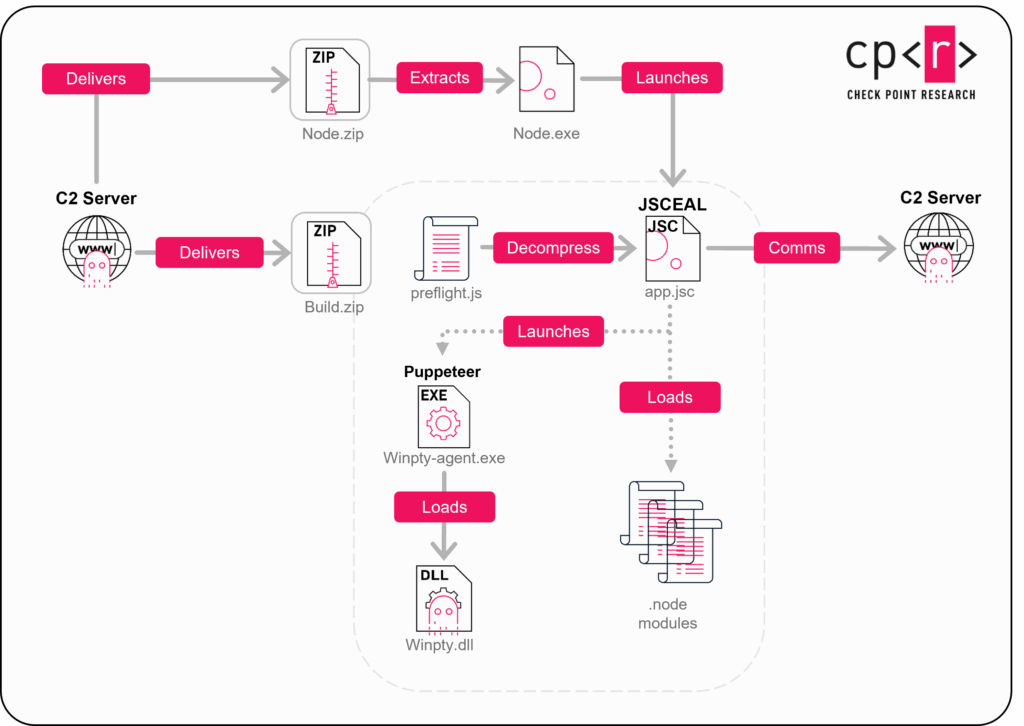
Research by: hasherezade Key Points Since early 2025, Check Point Research has been tracking JSCeal, a sophisticated cryptocurrency-focused stealer with broader credential-theft, surveillance, and traffic-interception capabilities, delivered as compiled V8 bytecode (JSC files). The payloads are protected with javascript-obfuscator , using multiple techniques…

Fix: Review advisory findings, isolate suspect endpoints, and verify threat signatures.
31st August – Threat Intelligence Report Moderate CVE-2026-81578 Check Point Research
2026-08-31 Check Point Research

31st August – Threat Intelligence Report

For the latest discoveries in cyber research for the week of 31st August, please download our Threat Intelligence Bulletin. TOP ATTACKS AND BREACHES Manchester Airports Group, the UK operator of Manchester, London Stansted, and East Midlands airports, has disclosed a cyberattack that exposed data belonging to about 8.7 million customers. The compromised info…

Fix: Review advisory findings, isolate suspect endpoints, and verify threat signatures.
Spring Ring: An Inside Look at Voice Phishing Campaigns in Microsoft Teams Important Palo Alto Unit 42
2026-08-31 Palo Alto Unit 42

Spring Ring: An Inside Look at Voice Phishing Campaigns in Microsoft Teams

Learn how the Spring Ring campaign abuses Microsoft Teams and voice phishing to deploy malware and target enterprise domain controllers. The post Spring Ring: An Inside Look at Voice Phishing Campaigns in Microsoft Teams appeared first on Unit 42 .

Fix: Review advisory findings, isolate suspect endpoints, and verify threat signatures.
ValleyRAT masquerading as adware Moderate Kaspersky Securelist
2026-08-31 Kaspersky Securelist

ValleyRAT masquerading as adware

Attackers typically try to pass off malware as legitimate applications or as potentially unwanted programs that users deliberately search for and download, such as cheats or cracks. They often rely on ad and affiliate networks to deliver their creations to victims’ devices. This post examines a less conventional case: a well-known backdoor distributed under …

Fix: Review advisory findings, isolate suspect endpoints, and verify threat signatures.
Perturbation Probing: A New Diagnostic for the Fragility of LLM Safety Moderate Palo Alto Unit 42
2026-08-28 Palo Alto Unit 42

Perturbation Probing: A New Diagnostic for the Fragility of LLM Safety

New research reveals that AI safety refusal lives in a thin neural layer, highlighting the critical need for external, multi-layered security. The post Perturbation Probing: A New Diagnostic for the Fragility of LLM Safety appeared first on Unit 42 .

Fix: Review advisory findings, isolate suspect endpoints, and verify threat signatures.
The Good, the Bad and the Ugly in Cybersecurity – Week 35 Moderate CVE-2026-36425 SentinelOne Threat Labs
2026-08-28 SentinelOne Threat Labs

The Good, the Bad and the Ugly in Cybersecurity – Week 35

The Good | Authorities Launch New Operations Against Cybercrime Networks & Supply Chain Attackers Operation Jackal IV, coordinated by INTERPOL across 22 nations, has led to the arrest of 58 individuals and the identification of over 200 suspects linked to West African cybercrime networks . The joint action successfully dismantled elements of the Black Axe sy…

Fix: Review advisory findings, isolate suspect endpoints, and verify threat signatures.
Metasploit Wrap Up: Payloads and Exploits, and Scanners, Oh my! Important Rapid7 Threat Research
2026-08-28 Rapid7 Threat Research

Metasploit Wrap Up: Payloads and Exploits, and Scanners, Oh my!

Latest threat intelligence analysis from Rapid7 Threat Research: Metasploit Wrap Up: Payloads and Exploits, and Scanners, Oh my!.

Fix: Review advisory findings, isolate suspect endpoints, and verify threat signatures.
Shai-Hulud hackers: two men charged over TeamPCP’s global supply chain crime spree that hit OpenAI, and thousands more Important Graham Cluley Security
2026-08-28 Graham Cluley Security

Shai-Hulud hackers: two men charged over TeamPCP’s global supply chain crime spree that hit OpenAI, and thousands more

More than 1,000 organisations, 500,000 stolen credentials, and one self-propagating worm named after a Dune sandworm - two men now face charges over TeamPCP's global hacking spree. Read more in my article on the Hot for Security blog.

Fix: Review advisory findings, isolate suspect endpoints, and verify threat signatures.
PaperCut NG/MF Critical Zero-Day Exploited in the Wild Critical CVE-2026-81578 Rapid7 Threat Research
2026-08-28 Rapid7 Threat Research

PaperCut NG/MF Critical Zero-Day Exploited in the Wild

Overview On August 27, 2026, PaperCut Software published an urgent security advisory stating that it is investigating active exploitation of a vulnerability affecting PaperCut NG and PaperCut MF. PaperCut has confirmed customer incidents and is treating the issue as a security emergency. At the initial time of disclosure, the vulnerability had not been assig…

Fix: Review advisory findings, isolate suspect endpoints, and verify threat signatures.
“Sorry, I can’t help with that”: How your guardrails might become the attacker’s best friend Important Cisco Talos Intelligence
2026-08-27 Cisco Talos Intelligence

“Sorry, I can’t help with that”: How your guardrails might become the attacker’s best friend

Welcome to this week’s edition of the Threat Source newsletter. Hello, everyone. Long time reader, first time writer here at the Threat Source newsletter! I wanted to start out by introducing myself. My colleague and friend Mick Baccio set the bar pretty high last week , so I was planning to tell you all about myself, including: How I did my first real IR un…

Fix: Review advisory findings, isolate suspect endpoints, and verify threat signatures.
PCI DSS 4.0.1: Application Requirements You’re Being Assessed On in 2026 Moderate Qualys Security Blog
2026-08-27 Qualys Security Blog

PCI DSS 4.0.1: Application Requirements You’re Being Assessed On in 2026

Key Takeaways Since March 31, 2025, all 51 former “best practice” requirements in PCI DSS 4.0 have been fully scored. Every 2026 assessment covers them. A large share of the new weight sits in the PCI DSS 4.0.1 application requirements , concentrated in Requirements 6 and 11: inventory of custom applications and APIs, continuous protection of public-facing a…

Fix: Review advisory findings, isolate suspect endpoints, and verify threat signatures.
OpenClaw went viral. Meet the maintainers building and securing it. Moderate GitHub Security Blog
2026-08-27 GitHub Security Blog

OpenClaw went viral. Meet the maintainers building and securing it.

What began as a personal experiment quickly became a global open source project with extraordinary momentum. OpenClaw is a personal AI assistant that runs on users’ devices and connects with the messaging channels they already use. Started by Peter Steinberger as a weekend project in November 2025, its GitHub repository has grown to approximately 388,000 sta…

Fix: Review advisory findings, isolate suspect endpoints, and verify threat signatures.
Notification